
Craignagapple Wind Farm
About the project
Perigus Energy, formerly Ørsted, is developing a new wind energy proposal to repower the Owenreagh I & II Wind Farms which have been operational since 1997 and 2008 respectively, and to modify and extend the consented Craignagapple Wind Farm which received planning permission in 2018 but has yet to be constructed.
With 14 wind turbines, this wind energy proposal would increase the total installed capacity across Owenreagh I & II Wind Farms and the consented turbines at Craignagapple from 24 MW to somewhere between 63 MW and 67 MW depending on the final candidate turbine selection and the final granted design. Such an increase would make a significant contribution towards helping meet the growing demand for renewable energy generation in Northern Ireland and help the transition to a low carbon future.
Development Location
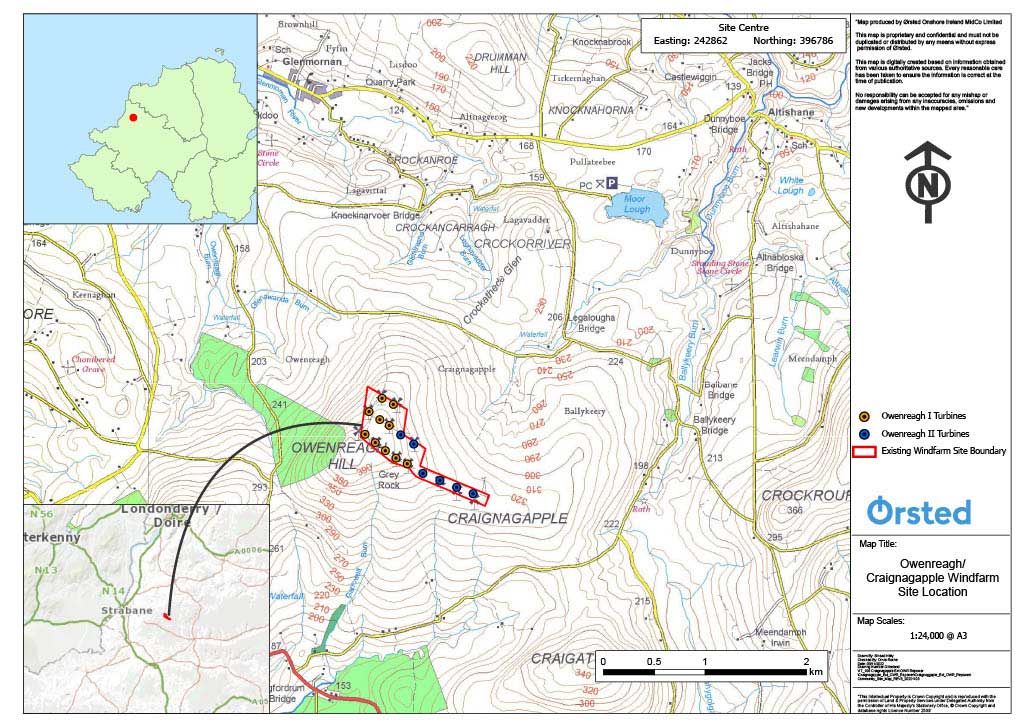
The operational Owenreagh I & II Wind Farms are located on the western edge of the Sperrin Mountains on Owenreagh Hill, approximately 6 km south east of Artigarvan village, Co. Tyrone, and lie within the Derry City and Strabane District Council (“DCSDC”) area.
View the site location map here
Proposed Turbine Layout
The proposed development consists of 14 new turbines with tip height of 156.5m. The final turbine locations and infrastructure design was informed by a number of different constraints, particularly avoiding areas of active peat and the deepest areas of peat, consultation with statutory consultees such as Environmental Health (noise), NIEA-NED (ecology including peat) and Landscape Architects Branch (Landscape and Visual Impact), and feedback from the community consultation events.
The map below shows the key infrastructure, including turbines, turbine hardstands, access roads, earthworks, substation and temporary construction compounds. More details on the design of these features is available in the Northern Ireland planning portal
Project History
Owenreagh Wind Farm I
Ten 0.55MW turbines were built in 1997. One of the ten turbines was removed in 2018 and the remainder operated until they were removed in 2024 when they reached the end of their life. By replacing this wind farm with taller, more powerful turbines, we’ll be able to make better use of the excellent wind resource at this location.
Owenreagh Wind Farm II
Six further turbines, of 0.85 MW each, which have been operational since 2009, with a total installed capacity of 5.1 MW. These turbines will also be removed and replaced with taller, more efficient ones as part of this project.
Current Craignagapple Consent
Consent was granted in 2018 for the construction and operation of six turbines adjacent to Owenreagh. The capacity of the site if constructed would be in the region of 14 MW. Similar to the plans for Owenreagh I & II we are proposing using taller, more powerful turbines which will help maximise the electricity generated from this location.
Project Timeline
September 2023
Planning Application was submitted to the Department for Infrastructure
Spring/Summer 2023
Planning application amalgamation and review
November 2022
Further Community Consultation Public Events took place
Summer/Autumn 2022
Final wind farm design completed (incorporating survey findings and feedback)
July 2021
Detailed environmental and engineering studies began
May 2021
DfI deemed the project to be regionally significant
April 2021
Environmental Assessment and Planning team appointed
May 2020
Additional ecological studies commenced
March 2020
Required two-year ecological studies completed
March 2018
General ecological studies began in the wider study area
Local Community
Community Benefit fund
As long-term owners, developers, and operators of renewable energy assets we seek to be active partners in the communities in which we develop projects.
We believe in giving back to the communities in which we work. In line with funds we have established in Scotland, we intend to offer an annual fund of £5,000 per MW. Depending on the final project design, this means a total fund of £300k-£335k per year which will be shared between community organisations surrounding the development. It will provide financial support to worthwhile initiatives that benefit the local community and local council area, enhance the local economy, and build social infrastructure.
We emphasise support to organisations that engage in:
- Community Services
- Educational Programmes
- Medical and Health Assistance
- Energy Efficiency and Sustainability
How will the Community Benefit Fund be distributed?
It is essential for Perigus Energy that Community Benefit Funds are distributed in an open and transparent manner. We believe that the process should be designed and decided on by the community. We usually engage an independent organisation with experience in managing community funds to assist us with the process, from consulting the local community on the design and management of the fund, inviting applications to the fund, recruiting a panel to review applications, to distributing funds to successful projects. If you are interested in becoming involved in this process, please let us know and we will contact you once it begins.
Wind Energy
Wind turbines harness the power of the wind to generate renewable electricity. Wind is one of the world’s fastest growing renewable energy sources and has become a major component in the energy mix. Wind power is clean, cost effective and does the same job as fossil fuels but generates much less waste. Northern Ireland has one of Europe’s strongest wind resources creating significant potential for the deployment of wind power to increase the proportion of energy produced from renewable sources. This trend is expected to continue as:
- The costs of wind energy continue to fall
- Threats to energy security persist across the globe
- The need to tackle climate change becomes increasingly urgent
- For the 12 month period January 2023 to December 2023, 45.8% of total electricity consumption in Northern Ireland was generated from renewable sources located in Northern Ireland. Wind energy contributed 83% of all renewable electricity during this period. (source: www.economy-ni.gov.uk/articles/electricity-consumption-and-renewable-generation-statistics)
- The Climate Change Act (Northern Ireland) 2022 received Royal Assent on 6 June 2022. The Act includes a target for net-zero emissions by 2050 as well as a set of interim targets for 2030 and 2040. It states “The Department for the Economy must ensure that at least 80% of electricity consumption is from renewable sources by 2030.”* One of the key ways to achieve this target is by increasing the proportion of renewable energy in the electricity sector. The recent energy crisis has highlighted our over-reliance on fossil fuels from overseas. Installing wind farms, such as this one, will help to secure Northern Ireland’s energy independence and help to shield us from excessive fossil fuel prices.
*Source: The Department of Economy
Latest News
July 2024
Additional information submitted to DfI planning for the Owenreagh/Craignagapple Project. An updated Environmental Statement (ES) for a scenario where the baseline for Environmental Impact Assessment excludes the Owenreagh I turbines was submitted to DfI. The possible alternative baseline scenario has not resulted in the identification of any effects considered to be significant nor identified the need for any change to the proposed mitigation set out in the 2023 ES.
December 2023
The non-material change application for the refurbishment of the Owenreagh I turbines was refused by Derry City & Strabane District Council.
November / December 2022
The Stage 2 public consultation events were held on 30 November 2022 (Fir Trees Hotel, Strabane) and 1 December 2022 (Owen Roe O’Neills GAC Club Rooms, Glenmornan). As part of the Stage 2 consultations, Ørsted hosted an additional dedicated consultation event in a local landowners’ farm premises (Rouses’ barn on 29 November 2022), to ensure that local residents could access project information in their immediate environs. Perigus Energy and the project team shared details of the wind farm layout and design, the Environmental Impact Assessment process and the planning application process. Feedback from the Stage 1 and Stage 2 public consultation events will be collated and included within the Pre-Application Community Consultation report that will be submitted as part of the planning application package.
November 2022
Third leaflet distributed to all houses within 3km of the proposed wind farm.
August 2022
Due to ongoing delays with the planning scoping process, the second community consultation event has been postponed until November 2022 and planning submission is now expected in Spring 2023.
February 2022
Due to ongoing delays with the planning scoping process, the second community consultation event has been postponed until August/September 2022 and planning submission is now expected in Winter 2022.
November 2021
First community consultation events held at Fir Trees Hotel in Strabane and Owen Roes’ GAC club rooms in Glenmornan.
Second leaflet distributed to community and other stakeholders.
October 2021
Update Flyer circulated to all homes within 3km of the development.
September 2021
First leaflet distributed to community and other stakeholders.
July 2021
EIA Scoping and PAD Report submitted to DfI.
May 2021
DfI Planning has confirmed that the project is considered regionally significant and they will be determining the planning application.
April 2021
Section 26 determination submitted to Department for Infrastructure.
Meet the Project Team

Olivia Roche
Perigus Energy’s Project Manager for the proposed wind farm development. Olivia has been involved in the renewable energy sector since 2014

Michael Nicholas
Community Liaison Officer for the proposed wind farm development. Michael is an experienced Communications Manager & lives locally to the project.
Contact us
Email: info@craignagapplewindfarm.com
Phone: +44 7733 210379 to speak with our Community Liaison Officer, Michael Nicholas